
Food Chain in Forest Ecosystems: Trophic Levels, Examples, and Energy Flow
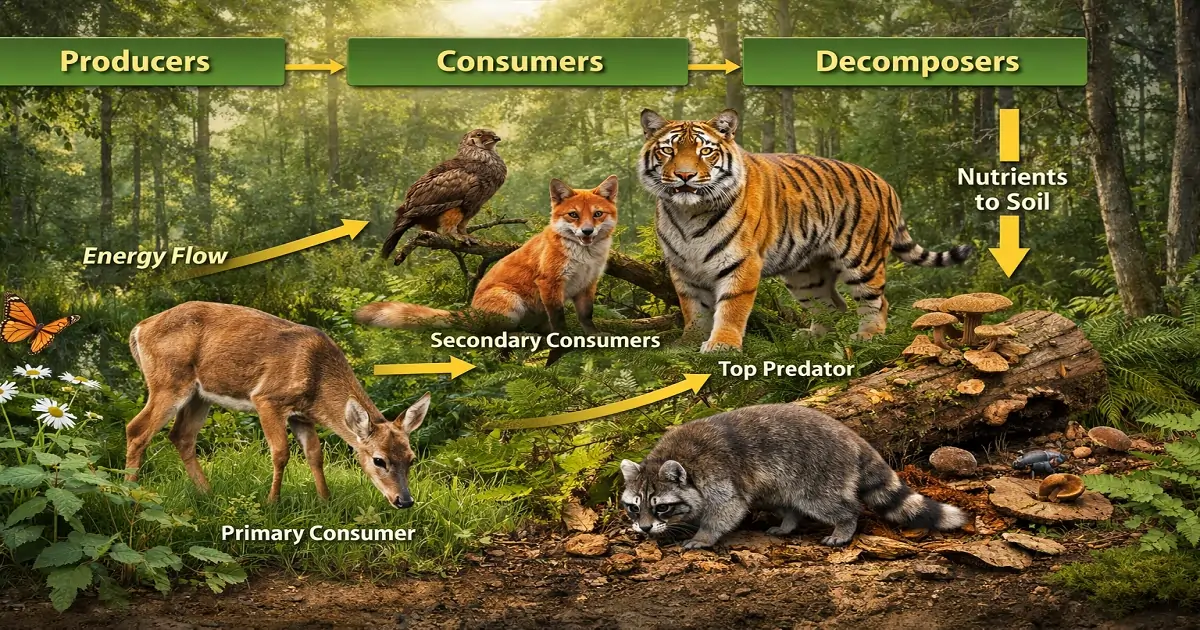
A forest food chain shows how energy moves from plants to animals and then to decomposers. In a food chain in a forest ecosystem, each organism depends on another for survival.
In forests, green plants capture sunlight and begin the flow of energy. Herbivores feed on plants, while carnivores depend on other animals. Decomposers break down dead matter and return nutrients to the soil.
However, forest food chains are not always simple or linear. They often overlap and form complex links. Understanding trophic levels and energy transfer helps explain how forests remain balanced.
What Is a Food Chain in a Forest Ecosystem?
A food chain in a forest ecosystem shows a simple path of who eats whom. It explains feeding relationships in forest life, often described as a food chain. Each step moves energy from one organism to another in a clear order.
In forests, the chain often begins with green plants. These plants use sunlight to make food. Herbivores then eat the plants, and carnivores feed on those animals. Finally, decomposers break down remains and return nutrients to the soil.
Therefore, a forest ecosystem food chain shows both energy transfer in forest ecosystem and survival links. It is a basic ecological food chain that helps explain balance in nature.
However, real forest systems are not always linear. Many food chains connect and form complex networks. This connection keeps ecosystems stable and supports biodiversity.
Trophic Levels in a Forest Food Chain
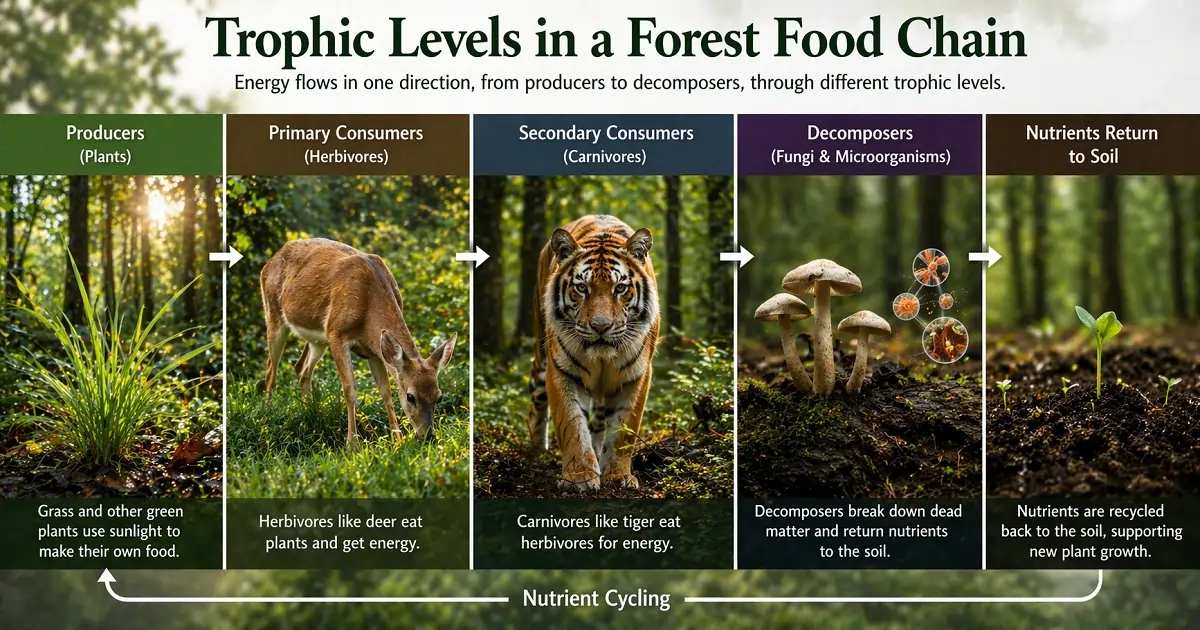
Trophic levels describe the position of organisms in a forest food chain. Each level shows how energy flows through living things. As energy moves upward, it decreases at each stage.
These levels help explain how forests support life. They also show how plants, animals, and microbes depend on each other.
Producers
Producers form the first trophic level in a forest food chain. These include trees, shrubs, and grasses. They are known as primary producers or autotrophs.
Green plants use sunlight to make food through photosynthesis. This process stores energy in leaves, stems, and roots. Therefore, producers supply energy to all other organisms in the forest ecosystem.
Primary Consumers
Primary consumers feed directly on producers. These are herbivores such as deer, rabbits, and insects. They depend on plant energy for survival.
These plant-eating animals transfer energy to higher levels. Besides, they help control plant growth and maintain balance in forest ecosystems.
Secondary and Tertiary Consumers
Secondary consumers eat herbivores, while tertiary consumers feed on other predators. These include animals like foxes, snakes, and big cats.
These carnivores and omnivores form higher-level consumers in the food chain. Furthermore, they regulate populations and prevent overgrazing. This predatory hierarchy keeps the ecosystem stable.
Decomposers
Decomposers play a vital role in forest food chains. Fungi, bacteria, and small insects break down dead plants and animals. They act as key decomposers in forest ecosystems.
This process returns nutrients to the soil, supporting new plant growth. Therefore, nutrient cycling continues without interruption.
Decomposers are biotic components of a forest ecosystem that sustain ecosystem health.
Examples of Forest Food Chains
Forest food chain examples help explain how energy moves through living things. These real-life food chains in forest ecosystems show simple and clear connections. Each step reflects how organisms depend on others for food.
Energy flow in ecosystems follows a one-directional path, where energy moves through different trophic levels.
One common example is grass → deer → tiger. Grass captures sunlight and stores energy. Deer feed on grass, and tigers hunt deer for survival.
Another example is leaves → caterpillar → bird → hawk. Leaves provide energy to caterpillars. Birds eat caterpillars, and hawks prey on birds at a higher level.
A different chain is fruits → monkey → leopard. Fruits attract monkeys, which act as primary consumers. Leopards, as predators, feed on monkeys and maintain balance.
Dead matter → fungi → insects → birds shows another pathway. Fungi break down dead material and release nutrients. Insects feed on this matter, and birds consume the insects.
These simple forest food chains highlight energy flow and survival links. However, many such chains exist together in forests. They often overlap and form complex systems that support biodiversity.
Forest Food Chain vs Forest Food Web
A forest food chain shows a straight path of energy flow. It follows a simple sequence from producers to top consumers. This linear model helps in basic understanding.
However, forests do not function in such a simple way. Multiple food chains connect and form a forest food web. These ecological networks in forest ecosystems are more realistic.
In a food web, one organism can have several food sources. For example, a bird may eat insects, fruits, and seeds. This flexibility increases survival chances.
Therefore, the difference between food chain and food web lies in complexity. Food webs support stability and reduce the risk of collapse. They also help maintain biodiversity in forests.
This interconnected structure relates closely to the forest ecosystem structure, where many interactions occur at once.
Energy Flow in Forest Food Chains
Energy flow in forest food chains moves in one direction. It begins with sunlight and passes through different trophic levels. Plants capture solar energy and convert it into food.
Energy then passes to herbivores and later to carnivores. However, only a small part moves to the next level. Most energy is lost as heat during each transfer.
The 10 percent rule explains this process clearly. Only about ten percent of energy passes to the next level. The remaining energy is used for growth, movement, and life processes.
Therefore, higher trophic levels receive less energy. This limits the number of top predators in a forest ecosystem. It also shapes the ecological energy pyramid.
Trophic energy flow helps explain why food chains remain short. Efficient energy transfer in food chain systems supports balance and sustainability.
Why Forest Food Chains Are Unique
Forest food chains are unique because of high biodiversity. Forests support many species of plants, animals, and microbes. This variety creates rich and active feeding links.
However, these links are rarely simple. Many chains overlap and form complex ecological relationships. One animal may feed at different levels, depending on food availability.
Dense vegetation also increases interaction among species. Trees, shrubs, and ground plants provide food and shelter. Therefore, organisms interact more closely than in open ecosystems.
These patterns also vary across forest types. Tropical regions such as Tropical Forest support highly complex feeding relationships due to rich biodiversity. In contrast, regions like Temperate Forest and colder areas such as Boreal Forest often have simpler chains with fewer species.
These differences influence how energy flows and how stable the system remains. As a result, forest ecosystems show strong resilience and adaptability under changing environmental conditions.
Threats to Forest Food Chains
Forest food chains face serious threats from human activities. These pressures disrupt feeding relationships and disturb energy flow. As a result, ecosystem balance becomes fragile.
Deforestation is one of the main causes of this imbalance. When trees are removed, many species lose shelter and food sources. This breaks links between producers, consumers, and decomposers.
Climate change adds further stress to forest ecosystems. Changes in temperature and rainfall alter plant growth patterns. Therefore, animals may struggle to find reliable food sources.
Habitat loss continues to weaken these connections. Species may migrate, decline, or disappear from certain areas. This affects both predators and prey and disrupts natural cycles.
Together, these changes reduce biodiversity and make food chains less stable. When key species are lost, the flow of energy becomes uneven and less efficient.
Protecting forests and restoring habitats can help rebuild these links. Stable ecosystems support balanced food chains and maintain consistent energy flow across trophic levels.
Conclusion
A forest food chain shows how energy moves through plants, animals, and decomposers. Each trophic level plays a role in maintaining balance within the ecosystem.
However, these relationships are not always simple. Forest food chains often overlap and form complex networks that support biodiversity and stability. These connections help ecosystems respond to natural changes.
Understanding energy flow explains how forests remain stable over time. It also shows how each organism, from producers to decomposers, contributes to the system.
When these links remain intact, forests continue to support life efficiently. This highlights the importance of maintaining healthy and balanced ecosystems for long-term sustainability.