
Grassland Food Chain: Trophic Levels, Energy Flow, and Examples
A grassland food chain shows how energy moves through plants, herbivores, carnivores, and decomposers within grassland ecosystems. It explains how organisms depend on one another as nutrients and energy move through different trophic levels. Grasses form the main energy source because they support many grazing animals and predators.
Grassland food chains help maintain ecological balance and population stability. Herbivores feed on grasses, while carnivores depend on herbivores for survival. At the same time, decomposers break down dead matter and return nutrients to the soil.
These feeding interactions strengthen biodiversity and ecosystem functioning across temperate grasslands, savannas, and other grass-dominated habitats. Understanding these food chains also explains how energy flow helps maintain stable grassland ecosystems over time.
What Is a Grassland Food Chain?
A grassland food chain is a sequence of organisms that transfer energy through feeding relationships within grassland ecosystems. It begins with producers such as grasses and small plants that capture sunlight through photosynthesis. This stored energy then moves to herbivores and later to predators at higher trophic levels.
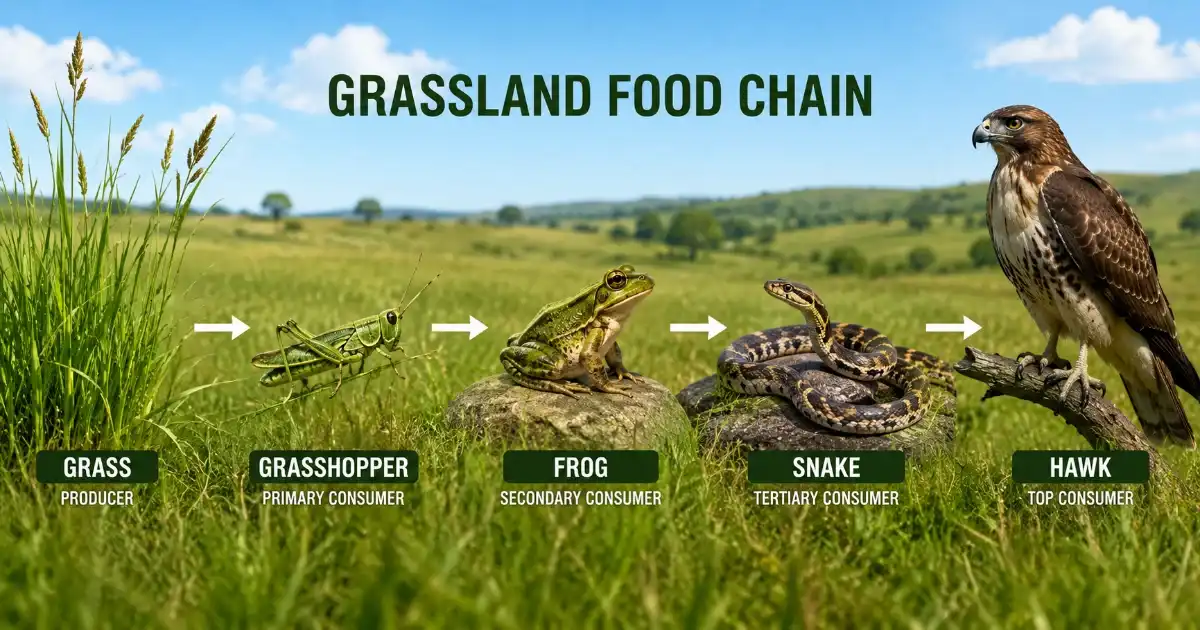
Grassland food chains show how organisms depend on one another for survival. For example, grasshoppers feed on grasses, frogs consume insects, and snakes prey on frogs. Hawks and other birds of prey may later feed on snakes. Therefore, energy moves continuously from one organism to another through feeding interactions.
Most grassland food chains begin with grasses because grassland ecosystems contain large areas of herbaceous vegetation. Herbivores such as rabbits, deer, antelope, and insects consume plant material and transfer energy to carnivores. Besides this, decomposers break down organic matter and recycle nutrients back into the soil.
These feeding sequences support ecological balance and population regulation within grassland habitats. Furthermore, grassland food chains help scientists understand energy flow, predator-prey relationships, and ecosystem stability across natural grassland environments.
Characteristics of Grassland Food Chains
Grassland food chains mainly depend on grasses and other small plants as the primary energy source. Producers capture sunlight and store energy through photosynthesis. This energy later moves through different trophic levels within the ecosystem feeding structure.
Most grassland food chains contain strong grazing relationships because herbivores feed directly on grasses. Animals such as rabbits, deer, antelope, zebras, and grasshoppers consume plant material and transfer energy to higher consumers. Therefore, grazing herbivores form an important link within grassland trophic relationships.
Predator-prey interactions also influence the balance of grassland ecosystems. Snakes, foxes, wolves, and birds of prey regulate herbivore populations through hunting activities. Balanced predator populations help prevent excessive grazing and support vegetation recovery across grassland habitats.
Grassland food chains are usually shorter than many forest or marine food chains. Energy decreases rapidly at each trophic level because organisms use most energy for movement, growth, and survival. As a result, fewer organisms exist at higher feeding levels.
Another important characteristic involves continuous nutrient recycling within grassland habitats. Decomposers break down dead organisms and return nutrients to the soil. Furthermore, this process supports healthy plant growth and maintains stable feeding relationships within grassland ecosystems.
How Energy Flows Through a Grassland Food Chain
Energy flow in a grassland food chain begins with sunlight. Grasses and other producers absorb solar energy through photosynthesis and convert it into chemical energy. This stored energy supports the entire feeding hierarchy within grassland ecosystems.
Herbivores obtain energy when they consume grasses and plant material. Rabbits, deer, insects, and grazing mammals transfer this energy to the next trophic level. Carnivores later receive energy by feeding on herbivores and smaller predators.
However, only a small amount of energy moves from one trophic level to another. Most energy is lost as heat during respiration, movement, digestion, and other biological activities. Therefore, energy gradually decreases at higher feeding levels within the ecosystem. Similar patterns of energy transfer in ecosystems also occur across many natural habitats.
Ecologists often describe this process through the 10% rule. According to this principle, organisms transfer only about ten percent of available energy to the next trophic level. The remaining energy supports life processes or escapes into the environment as heat.
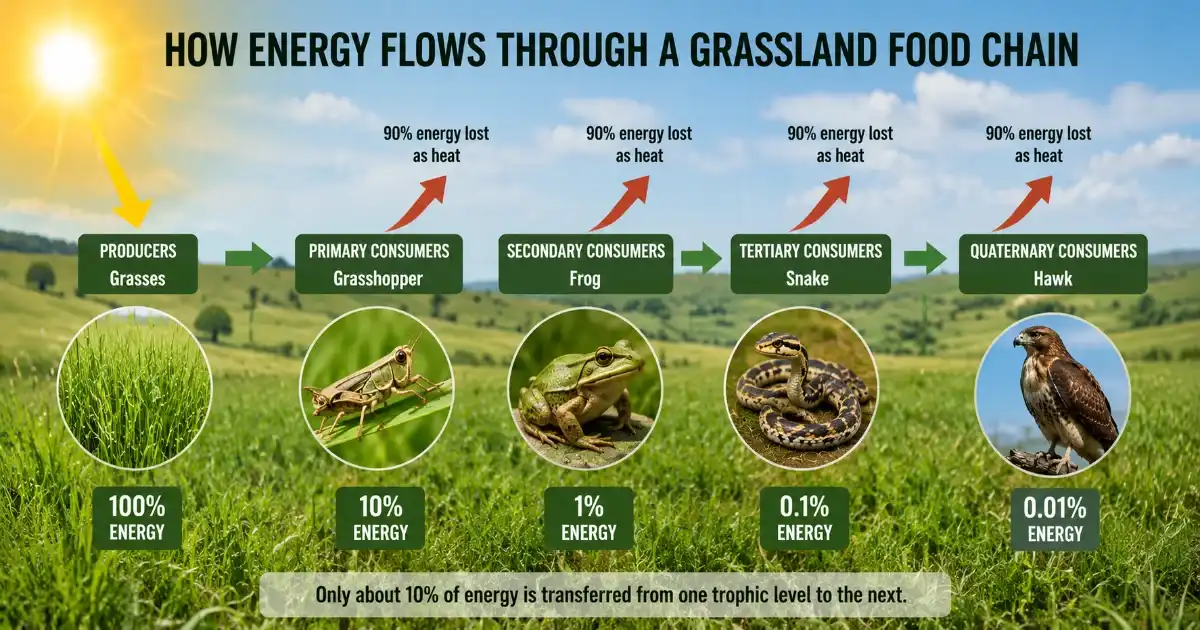
For example, grasses may contain large amounts of stored energy. Herbivores receive only part of that energy after feeding. Predators then obtain even less energy from herbivores. As a result, food chains cannot support large predator populations at the top levels.
Environmental conditions also influence energy movement within grasslands. Sunlight, rainfall, soil nutrients, and temperature affect plant growth and ecosystem productivity. Similar ecological interactions can also be understood through biotic and abiotic factors.
Trophic Levels in a Grassland Food Chain
Trophic levels describe the feeding positions organisms occupy within a grassland food chain. Each level transfers energy and nutrients to the next through feeding interactions. These trophic relationships help maintain population balance and ecosystem stability within grassland habitats.
Grassland food chains usually begin with producers and move upward through herbivores and predators. Each trophic level receives less available energy than the level below it. Therefore, higher trophic levels support fewer organisms than lower levels.
Different organisms perform different ecological roles within the feeding hierarchy. Producers capture solar energy, consumers transfer energy through feeding, and decomposers recycle nutrients after organisms die. Similar ecological roles can also be understood through producers, consumers, and decomposers.
Producers
Producers form the first trophic level in grassland ecosystems. Grasses, herbs, and small plants prepare food through photosynthesis and store solar energy. This stored energy supports every higher trophic level within the grassland food chain.
Primary Consumers
Primary consumers occupy the second trophic level and feed directly on producers. Grasshoppers, rabbits, deer, zebras, and antelope consume grasses and transfer plant energy upward through the food chain. Therefore, herbivores play an important role in grassland energy movement.
Secondary Consumers
Secondary consumers feed on herbivores and smaller animals within grassland ecosystems. Frogs, snakes, foxes, and wild cats often occupy this trophic level. These predators help regulate herbivore populations and maintain ecological balance within feeding systems.
Tertiary Consumers
Tertiary consumers occupy the highest trophic levels in many grassland food chains. Hawks, eagles, wolves, and large predators feed on secondary consumers and smaller carnivores. However, fewer tertiary consumers survive because limited energy reaches the top feeding levels.
Decomposers in Food Chains
Decomposers break down dead plants, animals, and organic waste within grassland ecosystems. Bacteria, fungi, worms, and insects help return nutrients to the soil. Furthermore, nutrient recycling supports fresh plant growth and maintains continuous energy movement.
Grassland Food Chain Examples
Grassland food chain examples help explain how energy moves through different trophic levels within ecosystems. These feeding relationships connect producers, herbivores, carnivores, and decomposers through continuous energy transfer. Different grassland habitats may contain slightly different food chains depending on climate and animal populations.
Some grassland food chains remain short and direct, while others involve multiple predators and feeding pathways. Grazing animals usually occupy lower trophic levels because grasses form the primary food source. Predators later obtain energy by feeding on herbivores and smaller consumers.
Simple Grassland Food Chain
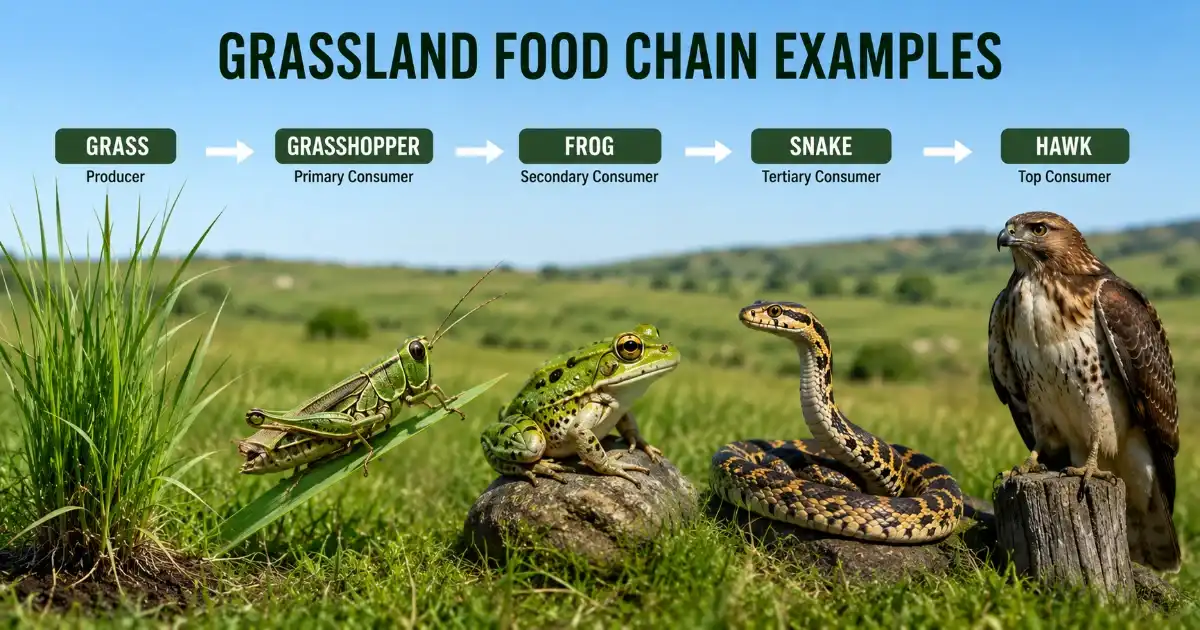
A simple grassland food chain often begins with grass as the producer. Grasshoppers feed on grasses and transfer energy to frogs. Snakes later consume frogs, while hawks prey on snakes at higher trophic levels.
Grass → Grasshopper → Frog → Snake → Hawk
This example shows how energy decreases gradually as it moves upward through the feeding hierarchy.
Grassland Food Chain with 4 Trophic Levels
Many grassland ecosystems contain four major trophic levels that support energy transfer. Producers capture sunlight, herbivores feed on plants, secondary consumers feed on herbivores, and tertiary consumers occupy the top level.
Grass → Rabbit → Snake → Hawk
Only a small amount of energy reaches the highest trophic levels. Therefore, top predators remain fewer in number within natural grassland habitats.
Grazing Food Chain Example
Grazing food chains begin directly with living green plants and grasses. Herbivores consume vegetation and transfer energy to predators through feeding interactions. These food chains dominate many temperate grasslands and savanna ecosystems.
Grass → Deer → Wolf
Large grazing mammals strongly influence grassland food chains because they consume significant amounts of vegetation. Besides this, predators help regulate herbivore populations and maintain ecological balance.
Temperate Grassland Food Web Example
Temperate grasslands often contain complex food webs instead of single feeding pathways. Grasshoppers, rabbits, mice, birds, snakes, foxes, and hawks interact through interconnected feeding relationships.
For example, hawks may feed on snakes, rabbits, or small rodents depending on food availability. Therefore, food webs increase ecosystem stability because organisms can use multiple food sources for survival.
Detritus Food Chain Example
Detritus food chains begin with dead organic matter instead of living plants. Decomposers break down fallen leaves, dead grasses, and animal remains into simpler substances. Small insects and worms then feed on decomposed material.
Dead Grass → Bacteria → Earthworm → Bird
These food chains help recycle nutrients and maintain soil fertility within grassland ecosystems. Furthermore, decomposers support continuous ecosystem productivity through nutrient movement.
Grassland Food Web Explained
A grassland food web shows how different food chains connect within an ecosystem. Unlike a single food chain, a food web contains multiple feeding pathways between organisms. These interconnected relationships help grassland ecosystems remain stable under changing environmental conditions.
Many grassland animals feed on more than one food source. For example, hawks may eat rabbits, snakes, insects, or small birds depending on food availability. Similarly, foxes often consume rodents, insects, and smaller herbivores within grassland habitats.
Food webs increase ecosystem stability because organisms can survive even if one food source declines. If insect populations decrease, predators may switch to rodents or other prey. Therefore, interconnected feeding pathways help maintain ecological balance across grassland ecosystems. Similar ecological patterns can also be observed in broader food web relationships.
Grassland food webs also regulate population growth through predator-prey interactions. Herbivores consume grasses, while carnivores help control herbivore numbers. Balanced feeding relationships prevent overgrazing and support healthy vegetation growth within natural habitats.
Different grassland ecosystems contain different food web structures depending on climate and biodiversity. Temperate grasslands, savannas, and prairie ecosystems support unique feeding interactions among plants and animals. Similar trophic relationships can also be understood through food chains in forest ecosystems.
Grassland Food Chain Pyramid
A grassland food chain pyramid shows how energy, biomass, and organism numbers change across trophic levels. Producers form the broad base of the pyramid because they contain the highest amount of stored energy. Higher trophic levels gradually become smaller because less energy remains available.
The energy pyramid explains how energy decreases as it moves through feeding levels. Grasses capture large amounts of solar energy through photosynthesis. Herbivores receive only part of that energy, while carnivores obtain even less from herbivores. Therefore, top predators remain fewer in number within ecosystems.
The biomass pyramid represents the total mass of living organisms at each trophic level. Producers usually contain the greatest biomass because grasslands support extensive plant growth. Herbivore biomass remains lower, while predator biomass becomes much smaller at higher levels.
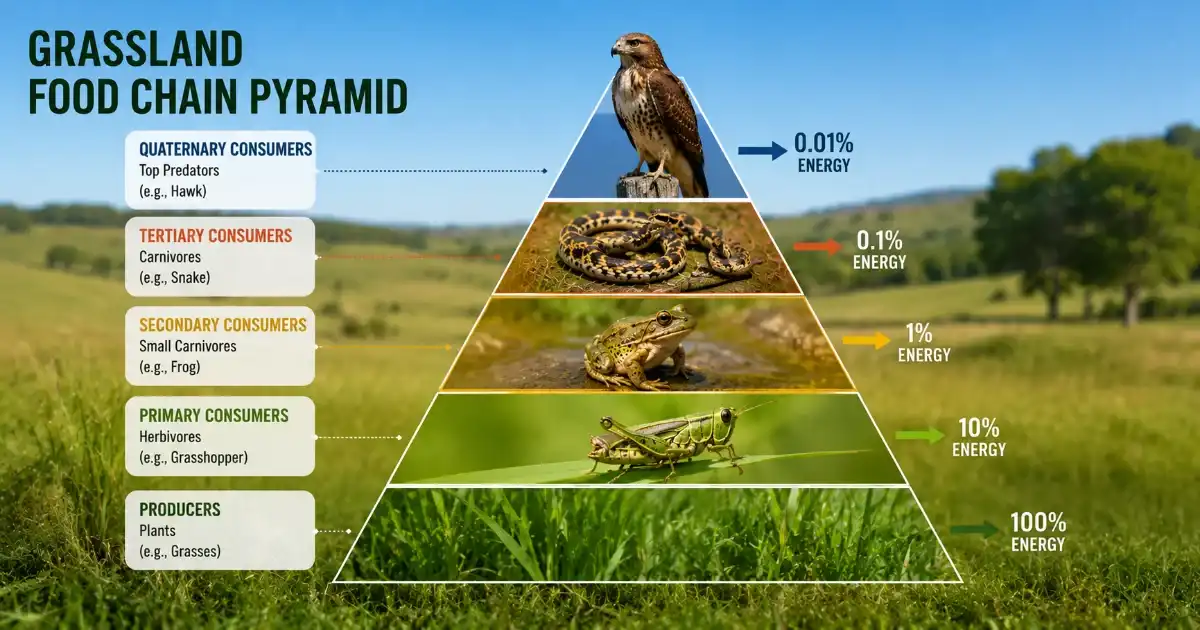
The trophic pyramid also explains feeding hierarchy within ecosystems. Lower trophic levels support larger populations because they receive more energy directly from producers. Furthermore, broader food chain concepts in ecosystems also explain how energy availability decreases at higher trophic levels.
These ecological pyramids help scientists understand energy movement, ecosystem productivity, and population balance within grassland food chains.
Importance of Grassland Food Chains
Grassland food chains help maintain balance and stability within natural ecosystems. Feeding relationships regulate populations and support continuous energy movement between producers, herbivores, carnivores, and decomposers. Therefore, healthy food chains maintain long-term ecosystem functioning.
These food chains also help maintain biodiversity across grassland habitats. Predators regulate herbivore populations and prevent excessive grazing on vegetation. Balanced grazing pressure supports healthy plant growth and improves habitat conditions for many organisms.
Energy transfer through trophic levels supports survival and ecological productivity within grasslands. Producers capture solar energy, while consumers distribute energy throughout the ecosystem. Besides this, decomposers recycle nutrients and support continuous plant growth.
Grassland food chains also help ecosystems respond to environmental changes. Stable feeding relationships improve ecosystem recovery after droughts, fires, and seasonal disturbances. Furthermore, balanced food chains regulate population stability and ecological resilience over time.
FAQs About Grassland Food Chains
Grassland food chains often raise questions about trophic levels, energy transfer, and feeding relationships within ecosystems. These frequently asked questions explain how organisms interact and maintain ecological balance across grassland habitats.
What is a grassland food chain?
A grassland food chain is a sequence of organisms that transfer energy through feeding interactions. It usually begins with grasses and moves through herbivores, carnivores, and decomposers within grassland ecosystems.
What are trophic levels in a grassland food chain?
Trophic levels describe the feeding positions organisms occupy within a food chain. Producers form the first level, herbivores occupy the second level, and predators belong to higher trophic levels.
Why are grasses important in grassland food chains?
Grasses act as primary producers because they capture sunlight and prepare food through photosynthesis. This stored energy supports herbivores and all higher feeding levels within grassland ecosystems.
What is the difference between a food chain and a food web?
A food chain shows one direct feeding pathway between organisms. However, a food web contains many interconnected feeding relationships and multiple energy pathways within ecosystems.
Why does energy decrease at higher trophic levels?
Organisms use most energy for movement, growth, respiration, and survival activities. Therefore, only a small amount of energy transfers to the next trophic level within the food chain.
Conclusion
Grassland food chains explain how energy moves through producers, herbivores, carnivores, and decomposers within ecosystems. These feeding relationships sustain trophic balance and help maintain stable ecological interactions across grassland habitats.
Higher trophic levels receive less available energy because much energy is lost during biological processes. Therefore, producers form the foundation of grassland ecosystems and support all higher feeding levels. Food webs further strengthen ecosystem stability through interconnected feeding pathways.
Predator-prey relationships, nutrient recycling, and balanced grazing also influence ecosystem productivity. Furthermore, healthy grassland food chains help maintain biodiversity, ecological stability, and long-term environmental balance within natural grassland ecosystems.